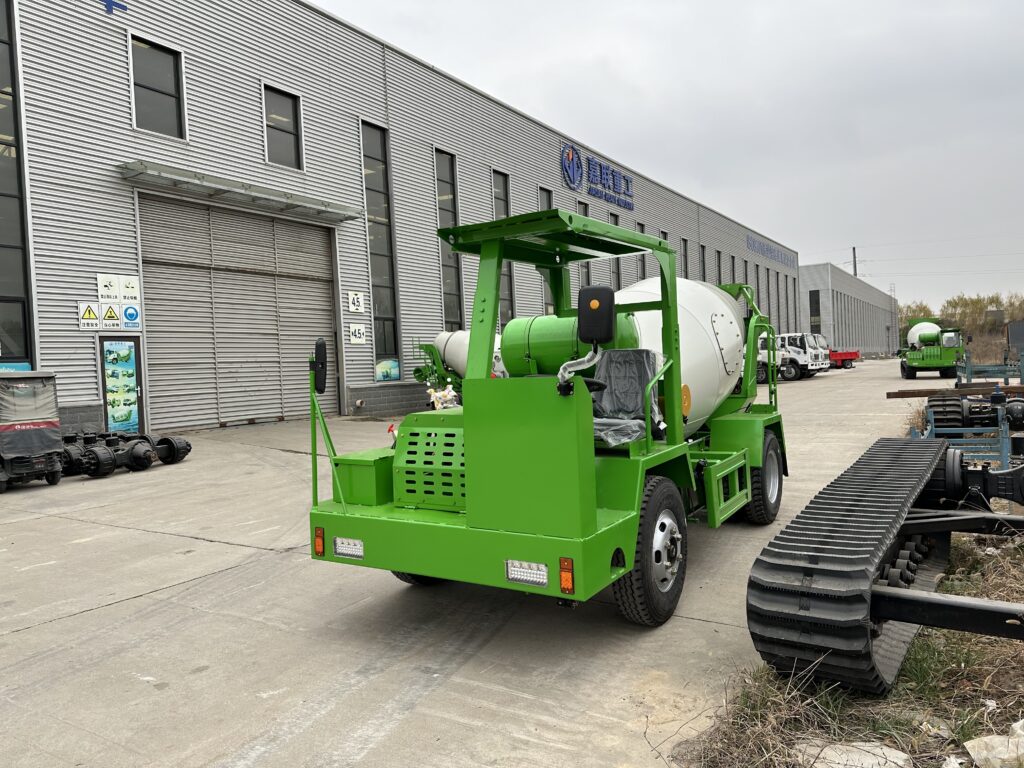

A concrete mixer truck with 4 wheel drive is designed to provide driving power to four wheels instead of relying only on a conventional two-wheel-drive configuration. This drivetrain layout can improve traction when a concrete mixer needs to travel on loose soil, muddy roads, slopes, gravel roads or other demanding construction surfaces.
For a mixer truck, four-wheel drive is not simply about adding power to the wheels. The complete drivetrain needs to work together, including the engine, transmission, transfer case, drive axles, differential, propeller shafts and tires.
This makes the 4WD system an important technical consideration when selecting a concrete mixer truck for demanding construction conditions.
What Is a Concrete Mixer Truck With 4 Wheel Drive?
A Concrete Mixer Truck With 4 Wheel Drive uses a four-wheel-drive drivetrain to transfer engine power to both the front and rear driven axles.
In a conventional two-wheel-drive vehicle, only one axle provides driving force. When road conditions become difficult, the driven wheels can lose traction.
A four-wheel-drive configuration distributes driving force through more driven wheels.
The basic power path can be described as:
Engine → Transmission → Transfer Case → Drive Shafts → Front and Rear Axles → Wheels
The exact drivetrain design varies by chassis and vehicle model.
The mixer drum has its own drive system, which may use hydraulic or other power transmission components. Therefore, the vehicle’s 4WD drivetrain and the drum drive system perform different functions.
The 4WD system moves the truck.
The mixer drive system rotates the drum.
How Does a 4WD Concrete Mixer Truck Work?
The main purpose of four-wheel drive is to improve the vehicle’s ability to transfer available engine torque to the road surface.
When the vehicle travels on a firm and level road, traction is usually not a major problem.
However, construction sites can have very different surfaces, including:
- Mud
- Gravel
- Loose soil
- Sand
- Wet roads
- Slopes
- Uneven ground
- Rocky construction areas
On these surfaces, the available traction can become a limiting factor.
The 4WD drivetrain allows the vehicle to use more driven wheels. This can reduce dependence on a single driven axle and help the truck maintain forward movement when road grip is limited.
However, four-wheel drive does not eliminate the effects of poor ground conditions. Tire selection, axle load, ground clearance, engine torque and road conditions all affect actual vehicle performance.
Main Components of a 4WD Concrete Mixer Truck
A four-wheel-drive mixer truck is a complete drivetrain system rather than a single component.
Several major components work together.
Engine
The engine generates the mechanical power required to move the vehicle.
Engine output includes torque and power. Torque is particularly important when a heavy vehicle starts moving or climbs a slope.
The required engine specification depends on the vehicle’s total weight, mixer capacity, road conditions and drivetrain configuration.
A larger engine is not automatically the best choice. The engine should be matched with the transmission and axle system.
Transmission
The transmission changes the relationship between engine speed and wheel speed.
Lower gears can provide higher wheel torque at lower vehicle speeds, which is useful when starting with a loaded mixer or traveling on a steep section of road.
The transmission therefore plays an important role in how engine power reaches the wheels.
Transfer Case
The transfer case is a key component in a four-wheel-drive system.
It receives power from the transmission and distributes it to the front and rear drivetrains according to the vehicle’s design.
On some 4WD vehicles, the transfer case can provide different operating modes.
The exact modes depend on the chassis configuration and should be checked in the manufacturer’s specifications.
Drive Shafts
Drive shafts transfer rotational power from the transmission or transfer case to the axles.
The shaft design needs to withstand the torque generated by the drivetrain.
For vehicles working on uneven ground, drivetrain components may also experience changing loads as the wheels move over different surfaces.
Front and Rear Axles
The axles transfer torque to the wheels.
In a 4WD concrete mixer truck, both front and rear axles can contribute to vehicle propulsion when the four-wheel-drive system is engaged or configured for four-wheel drive.
Axle capacity must also match the vehicle’s total operating weight and load distribution.
Differentials
Differentials allow wheels on the same axle to rotate at different speeds when the vehicle turns.
This is important because the inner and outer wheels follow different paths during a turn.
The differential design and any available differential-lock function depend on the chassis.
Tires
Tires are the final contact point between the drivetrain and the ground.
Even a powerful 4WD system cannot create traction if the tires cannot effectively grip the surface.
For a 4 Wheel Drive Concrete Mixer Truck, tire selection should therefore consider:
- Road surface
- Load
- Tread pattern
- Tire size
- Ground conditions
- Expected operating speed
Why Does 4WD Improve Mixer Truck Traction?
Traction is one of the most important technical reasons to choose a 4WD Concrete Mixer Truck.
The maximum usable driving force depends partly on the normal load acting on the driven wheels and the available friction between the tire and the ground.
A simplified relationship is:
Traction Force ≈ Tire-Ground Friction × Normal Load
When only two wheels are driven, the vehicle relies primarily on the traction available at those driven wheels.
With four-wheel drive, the available driving force can be distributed across more wheels.
This can be particularly useful when the road surface has limited grip.
For example, when one driven wheel begins to slip on a loose or muddy surface, the vehicle may have difficulty converting engine torque into forward movement.
A properly designed 4WD system can provide driving force through additional wheels, helping the vehicle make better use of available traction.
 4WD and Loaded Concrete Mixer Trucks
A concrete mixer truck operates differently from an empty chassis.
When the mixer drum contains concrete, the total vehicle weight increases.
This affects:
- Axle loads
- Tire loads
- Braking requirements
- Acceleration
- Climbing performance
- Suspension loading
- Drivetrain loads
The load inside the rotating drum can also change how the vehicle behaves during transportation.
Therefore, a Concrete Mixer Truck With 4 Wheel Drive needs to be evaluated based on its loaded operating condition, not just its empty vehicle performance.
This is especially important when the truck is expected to travel on slopes or unpaved construction roads.
4WD and Climbing Performance
Slope operation requires sufficient traction as well as sufficient engine and drivetrain torque.
When a loaded mixer truck travels uphill, the drivetrain must overcome several types of resistance.
These can include:
- Vehicle weight
- Rolling resistance
- Grade resistance
- Tire deformation
- Surface resistance
A simplified expression for grade resistance is related to vehicle weight and road gradient.
As the slope becomes steeper, the force required to move the vehicle uphill increases.
Four-wheel drive can help by providing driving force through both axles.
However, 4WD does not mean that a truck can climb any slope.
Actual climbing ability depends on:
- Engine torque
- Transmission gear ratio
- Transfer case ratio
- Axle ratio
- Tire grip
- Vehicle weight
- Road surface
- Slope
- Ground clearance
For this reason, buyers should look at the complete drivetrain specification instead of judging a truck only by the term “4WD.”
4WD for Rough and Unpaved Roads
Construction projects do not always provide good roads for material transportation.
A mixer truck may need to travel from a main road to a construction area using temporary access roads.
These roads may contain:
- Loose gravel
- Mud
- Ruts
- Stones
- Uneven surfaces
- Wet sections
- Steep sections
A Concrete Mixer Truck For Rough Roads needs more than a powerful engine.
The chassis, suspension, axles, tires, ground clearance and drivetrain all need to work together.
A four-wheel-drive configuration can be one part of this overall design.
For particularly demanding applications, buyers should also evaluate the protection and routing of drivetrain and hydraulic components.
4WD vs. 2WD Concrete Mixer Trucks
The choice between two-wheel drive and four-wheel drive should be based on the actual operating environment.
2WD Mixer Truck
A conventional 2WD mixer can be a practical choice for:
- Paved roads
- Urban construction
- Good-quality access roads
- Relatively flat construction areas
- Normal transportation conditions
It can provide a simpler drivetrain configuration when additional traction is not a major requirement.
4WD Mixer Truck
A Four Wheel Drive Concrete Mixer Truck may be more suitable when the vehicle frequently encounters:
- Muddy roads
- Gravel roads
- Steep access roads
- Loose soil
- Uneven construction sites
- Remote project roads
The additional drivetrain components can increase vehicle complexity and weight, so 4WD should be selected when its traction benefits are actually needed.
How 4WD Affects Vehicle Weight and Axle Load
Adding a four-wheel-drive system generally means additional drivetrain components.
These can include:
- Front drive axle
- Transfer case
- Additional drive shaft
- Differential components
- Related chassis components
These components contribute to vehicle weight.
At the same time, the concrete mixer itself carries a significant working load.
Therefore, the axle load needs to be considered carefully.
When selecting a 4WD mixer truck, buyers should check:
- Gross vehicle weight
- Front axle capacity
- Rear axle capacity
- Mixer drum weight
- Maximum concrete load
- Tire load rating
- Weight distribution
The mixer capacity should not be considered separately from chassis capacity.
4WD and Ground Clearance
Ground clearance is another important factor for off-road mixer applications.
When a mixer truck travels across uneven ground, the chassis and drivetrain can encounter obstacles such as:
- Rocks
- Raised soil
- Deep ruts
- Construction debris
- Uneven road edges
Adequate ground clearance can reduce the risk of components contacting the ground.
However, increasing ground clearance can also affect vehicle center of gravity and overall dimensions.
Therefore, the chassis should be selected according to the actual working environment rather than simply maximizing ground clearance.
 How to Choose a Concrete Mixer Truck With 4 Wheel Drive
Choosing the right Concrete Mixer Truck With 4 Wheel Drive requires looking at the complete vehicle specification.
1. Determine the Mixer Capacity
Start with the required concrete output per working cycle.
A small construction project may need a compact mixer, while larger projects may require greater drum capacity.
For smaller applications, a Small Concrete Mixer Truck For Small Projects can provide a more compact vehicle configuration.
2. Evaluate Road Conditions
Describe the actual road instead of simply telling the manufacturer that the truck will be used “off-road.”
Useful information includes:
- Road material
- Maximum slope
- Road width
- Mud conditions
- Average travel distance
- Presence of water
- Frequency of rough-road operation
This information can help determine whether 4WD is actually necessary.
3. Check Drivetrain Specifications
Important specifications include:
- Engine torque
- Transmission type
- Gear ratios
- Transfer case
- Axle configuration
- Differential
- Tire specification
- Ground clearance
These specifications should be considered as one drivetrain system.
4. Consider the Loaded Condition
The truck should be evaluated when carrying its intended concrete load.
A vehicle that performs well when empty may behave differently when fully loaded.
5. Consider the Mixer Drive System
The vehicle drivetrain and drum drive system should be evaluated separately.
For example, a hydraulic mixer system may use a hydraulic pump and motor to rotate the drum.
A Concrete Mixer Truck With Hydraulic System therefore has two important power-related systems: the vehicle drivetrain and the mixer drum drive.
They should be properly matched to the engine and chassis.
4WD Concrete Mixer Truck for Different Applications
A 4WD mixer truck can be configured for different construction environments.
Rural Construction
Rural construction sites may have narrow or unfinished access roads.
A Small Concrete Mixer Truck For Rural Construction can be configured with a suitable chassis and drivetrain depending on road conditions.
If the access road includes mud or steep sections, four-wheel drive may provide additional traction.
Mountain Construction
Mountain roads often combine slopes, uneven surfaces and limited road width.
The vehicle needs to balance:
- Traction
- Dimensions
- Ground clearance
- Turning radius
- Weight
- Load capacity
Four-wheel drive can be considered as part of the overall configuration.
Mining and Remote Construction
Mining and remote projects may involve rough roads and limited infrastructure.
In these conditions, drivetrain durability, tire selection, ground clearance and maintenance access become important.
A Self Loading Concrete Mixer Truck For Remote Areas may also be considered when the project requires loading, mixing, transportation and discharge functions in one machine.
Difficult Terrain
For particularly demanding construction environments, the complete vehicle specification should be evaluated.
A Concrete Mixer Truck For Difficult Terrain may require a combination of 4WD, suitable tires, appropriate axle capacity, sufficient ground clearance and a chassis designed for the expected operating conditions.
Common 4WD Drivetrain Problems
Regular inspection is important for maintaining a 4WD mixer truck.
Drivetrain Noise
Unusual noise may come from the transmission, transfer case, differential, drive shaft or axle.
The source should be identified before continued heavy operation.
Vibration
Driveline vibration can be related to drive shaft components, joints, wheel balance or other mechanical issues.
Tire Wear
Uneven tire wear may indicate incorrect tire pressure, alignment problems, suspension issues or drivetrain-related problems.
Differential or Transfer Case Problems
Low lubricant levels, contamination or component wear can affect drivetrain operation.
Maintenance requirements should follow the chassis manufacturer’s recommendations.
Maintenance of a 4 Wheel Drive Concrete Mixer Truck
A 4WD mixer truck should be maintained as a complete vehicle.
Regular maintenance should include:
- Checking engine oil
- Inspecting transmission fluid
- Checking transfer case lubricant
- Inspecting axle lubricant
- Checking differential components
- Inspecting drive shafts and joints
- Checking tire pressure
- Inspecting tire tread
- Checking suspension components
- Inspecting hydraulic mixer components
For trucks operating on mud, dust or rough roads, inspection frequency may need to increase according to actual operating conditions.
Keeping drivetrain components properly lubricated is particularly important because the transmission, transfer case, differentials and axles operate under significant loads.
Is 4WD Always Better for a Concrete Mixer Truck?
Not necessarily.
Four-wheel drive provides an important traction advantage, but it also adds mechanical components, weight and drivetrain complexity.
For a truck that mainly operates on paved urban roads, a 2WD configuration may already provide sufficient performance.
For a truck that frequently travels through mud, loose soil, slopes or rough construction roads, 4WD can provide meaningful benefits.
The correct question is therefore not:
“Is 4WD better?”
The better question is:
“Does this project require four-wheel drive?”
This approach helps buyers avoid paying for unnecessary specifications while ensuring that the truck has the drivetrain capability required by the jobsite.
Technical Specifications to Compare Before Buying
When comparing different 4WD Concrete Mixer Trucks, consider more than mixer capacity.
| Specification | Why It Matters |
|---|---|
| Engine torque | Affects available driving force |
| Transmission | Controls torque and vehicle speed |
| Transfer case | Distributes power to driven axles |
| Axle capacity | Supports vehicle and concrete load |
| Differential | Allows wheel-speed differences during turns |
| Tire specification | Directly affects ground traction |
| Ground clearance | Important on uneven terrain |
| Gross vehicle weight | Determines overall loading condition |
| Mixer capacity | Determines concrete load |
| Drum drive system | Controls mixer drum rotation |
| Suspension | Affects ride and load handling |
| Vehicle dimensions | Important for restricted access |
Looking at these specifications together gives a much better understanding of the truck’s actual capability.
Frequently Asked Questions
What is a concrete mixer truck with 4 wheel drive?
A concrete mixer truck with 4 wheel drive uses a drivetrain that can provide driving force through both the front and rear axles. It is commonly considered for construction sites where additional traction is required.
Does 4WD make a concrete mixer truck better on muddy roads?
4WD can improve the ability to transfer engine torque to the ground when traction is limited. However, actual performance also depends on tires, vehicle weight, axle load, ground conditions and drivetrain design.
Is 4WD necessary for every concrete mixer truck?
No. If the truck mainly operates on paved or good-quality roads, 2WD may be sufficient. 4WD becomes more useful when the truck regularly operates on rough, muddy, loose or sloped roads.
Does 4WD increase the weight of a mixer truck?
A 4WD drivetrain generally adds additional components such as a transfer case, front drive axle and drive shaft. The actual weight difference depends on the chassis configuration.
Does 4WD affect concrete mixer drum operation?
The 4WD drivetrain moves the truck, while the mixer drum has its own drive system. These systems perform different functions but both need to be matched to the overall vehicle design.
What should I check when buying a 4WD concrete mixer truck?
Check the engine, transmission, transfer case, axles, differential, tires, ground clearance, gross vehicle weight and mixer drum specifications. The complete vehicle should match the actual road and construction conditions.
Conclusion
A Concrete Mixer Truck With 4 Wheel Drive is a technical combination of a concrete mixer and a four-wheel-drive vehicle chassis. Its performance depends on how the engine, transmission, transfer case, axles, differential, tires and mixer system work together.
The biggest advantage of 4WD is not simply “more power.” It is the ability to transfer available engine torque through more driven wheels when road traction is limited.
For projects involving muddy roads, loose soil, slopes, gravel roads or uneven construction sites, 4WD can be an important part of the vehicle configuration.
However, four-wheel drive should always be selected according to the actual application. Mixer capacity, loaded weight, axle capacity, tire specification, ground clearance and drum drive requirements should all be evaluated together.
If you are looking for a Concrete Mixer Truck With 4 Wheel Drive, provide the required mixer capacity, road conditions, maximum slope, vehicle dimensions and construction application. A suitable drivetrain and mixer configuration can then be selected according to the actual project requirements.